

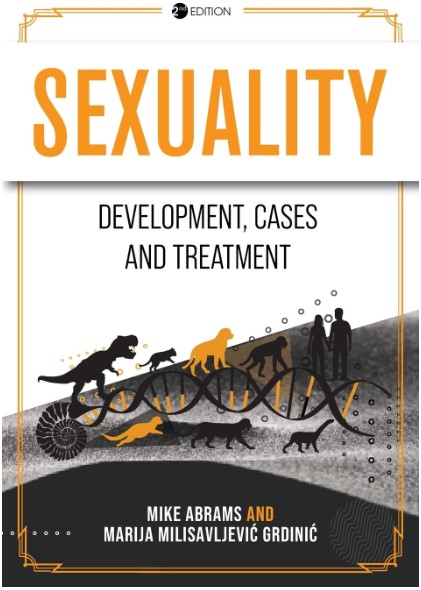
Psychologists Mike Abrams and Marija Milisavljević Grdinić recently published their newest treatise on human relationships and psychology, the academic textbook Sexuality: Development, Cases, and Treatment.
Sexuality is the sixth book Mike Abrams has either authored or co-authored. For Abrams, the book represents the culmination of over three decades of clinical research and teaching. As a professor at NYU and a fellow and supervisor at the Albert Ellis Institute, he has studied and written extensively on the topic of human sexuality, its connections to evolutionary psychology, and its effects on behavior and identity. Outside of these projects, he has also collaborated with evolutionary psychologist David Buss on research connecting evolutionary psychology to cognitive behavioral therapy (CBT).
For Grdinić, the book is another entry in her versatile bibliography of research in psychology and leadership, in which she has explored topics such as business strategy and research techniques like data analysis. She is also known for her workshop leadership and her work in the publishing and editing of scientific research.
The book is written in a style that is both academic and accessible. While it draws from over 900 references and 35 years of practical experience in psychology clinics, it does not sacrifice readability and practicality despite its academic rigor. The text takes a multifaceted and multidisciplinary approach to the topic of human sexuality, drawing from disciplines such as psychology, biology, and evolutionary theory and exploring topics such as emotion, attachment, and choice.
This book’s greatest strength is its exploration of the human side of sexuality. Mike Abrams and Grdinić’s writing keeps the text both informative and relatable. Its faithfulness to academic rigor has resulted in an avoidance of cultural and moral bias, and it does a relatively good job of explaining complex topics in a clear, easy-to-follow manner. However, for readers looking for a surface-level introduction to the topic, the book may be a bit dense.
This comprehensive primer will be best for people interested in studying the topic in detail. For those readers, the book explains the material in an engaging manner while unpacking the evolutionary reasoning behind sexual attraction, the psychology of intimate relationships, and the interactions between the body, the brain, and the emotions during intimacy.
Throughout the ages, the topic of human sexuality has been the subject of art, academic literature, and daily conversations. The depths of this topic cannot be fully covered within the pages of any one book. Despite this, Mike Abrams and Grdinić have done an admirable job presenting insights about the topic based on scientific evidence and clinical experience. This book is a worthy addition to the libraries of students and scholars who have made the study of human sexuality their life’s work. It is also an appropriate textbook for universities with psychology departments that are interested in having their students examine this topic in-depth.
 Alison Brown
 Kirsti Potter