

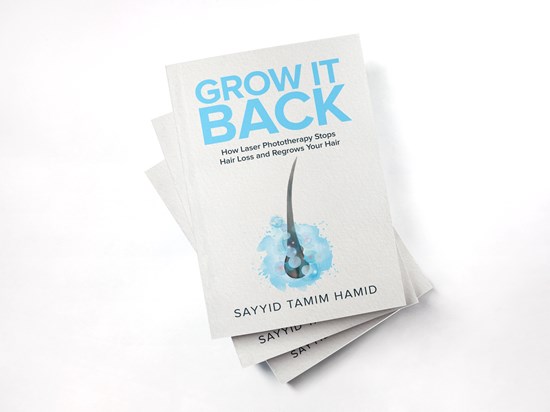
There are many different types of hair loss books out there, ranging from “breathless miracle cure” types to highly technical, science-focused texts that may be difficult for someone without a science background to understand. “Grow It Back” avoids both of these pitfalls. Written by Tamim S. Hamid, a former NASA scientist and biomedical engineer, “Grow It Back” is a comprehensive guide to LPT that is still accessible to everyday readers dealing with a problem like hair loss.
Ultimately, “Grow It Back” is a book about education. From the very beginning, it is made very clear that the author is not looking to preach or make any promises of a quick fix. He is looking to educate readers on what exactly hair loss is, why it happens, and how different treatments actually work. From there, readers are taken on a journey through the biology of hair growth, with enough science to make it credible without making it overwhelming. One of the best things about “Grow It Back” is that it does a very thorough job of explaining what causes hair loss. From genetics to hormones, stress, diet, and even environmental factors, readers get a well-rounded view of why they may be dealing with a problem like hair loss. They quickly realize that it is not caused by a single factor.
When Hamid turns his attention to laser phototherapy, he does so in a remarkably measured way. He describes how low-level laser light interacts with cells, why light is important for healing in all parts of the body, and how LPT is different from other light therapies. Importantly, he also discusses safety and usage, such as time constraints and results. It can take months, and for severe cases of hair loss, it may not work as well as it does for people experiencing hair thinning. It is this type of measured approach that helps make the book feel more credible, especially within a field that is so often fraught with hyperbole.
Another section of the book that is particularly well-written is the chapter dedicated to the myths surrounding laser phototherapy. Hamid addresses all of the concerns people might have, such as whether or not laser therapy can harm the skin, whether or not there is heat involved, and how people can recognize a good laser device versus a bad one. It is by addressing all of these issues that he is able to speak to the skepticism people might have, especially if they have been around for as long as laser therapy has been available.
The tone of the book is remarkably encouraging, but also does not dismiss people’s frustrations. Hair loss is not treated as something trivial, but as something that can really impact people’s self-esteem and sense of self. Hamid’s tone is such that he is able to write as someone who is not only well-versed in the technology but also someone who has experienced hair thinning himself.
However, it is also important for readers of the book to understand that it is written in such a way that laser phototherapy is presented as being the most effective solution for hair thinning. While Hamid does cite studies and research, there is also a sense of narrative that pushes readers towards LPT as being the way to go. Some readers might appreciate this, but others might want something a bit more even-handed. However, there is enough information presented so that readers can make up their own minds.
In terms of structure, the book is well organized and easy to follow. The chapters are logically structured, and technical terms are explained clearly. This is helpful as the book is aimed at people with no scientific knowledge.
On the whole, “Grow It Back” can be viewed as a success from the point of view of providing a practical and scientific approach for those who wish to understand more about the subject of hair loss and the various treatments available today. It does not resort to sensationalism and provides readers with a considered approach based on scientific research and knowledge. It can be highly recommended for those who wish to understand more about the subject of hair loss and laser phototherapy.
 Alison Brown